
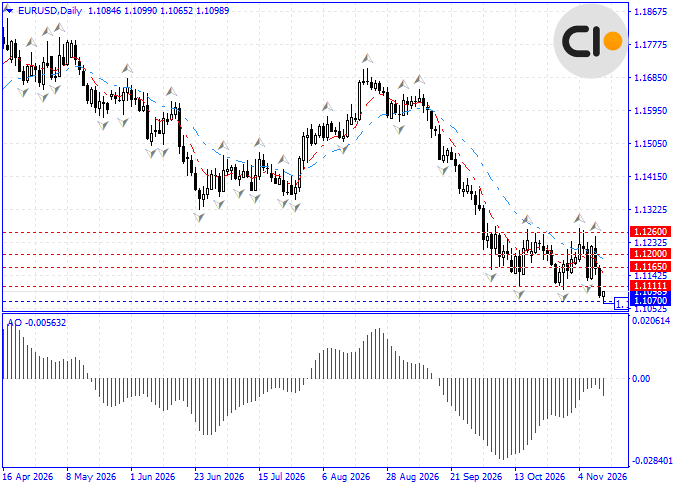
The key support and resistance level ahead for EUR/USD are as follows:
- Third key resistance level of EUR/USD: 1.12000
- Second key resistance level of EUR/USD: 1.11650
- First key resistance level of EUR/USD: 1.11111
- First key support level of EUR/USD: 1.10700
- Second key support level of EUR/USD: 1.10000
- Third key support level of EUR/USD: 1.09000
EUR/USD Analysis | 12 November 2026
EUR/USD has been in a downtrend over the past several months, during which sellers have pushed the pair to a low of 1.10654, the lowest level recorded in the current decline so far.
US Dollar: Fundamental Overview
The US Dollar Index (DXY) has reached its highest level in 19 months, driven by stronger-than-expected inflation data and an increasingly hawkish stance from the Federal Reserve. The dollar continues to benefit from strong fundamental support.
October’s Consumer Price Index (CPI) rose by 0.4% month on month, while core inflation increased by 0.3%, highlighting persistent price pressures and reinforcing expectations of an interest rate hike at the Fed’s December meeting.
Meanwhile, the addition of 165,000 nonfarm payroll jobs in October, alongside an unemployment rate of 4.1%, underscores the resilience of the US labour market. These conditions strengthen the Federal Reserve’s ability to maintain its restrictive monetary policy stance.
Rising US Treasury yields and a widening short-term yield differential between the US and Europe have further enhanced the relative appeal of dollar-denominated assets. However, markets have already largely priced in a 25-basis-point interest rate hike in December.
In the eurozone, October’s preliminary annual inflation estimate of 4.0% has been driven largely by rising energy prices. Meanwhile, core inflation of 2.5%, coupled with concerns over the impact of higher energy costs on economic activity, has complicated the European Central Bank’s monetary policy decisions.
Nevertheless, the possibility of an ECB rate hike in December suggests that European monetary policy could also become more restrictive, potentially limiting some of the downward pressure on the euro.
In the near term, the release of the US Producer Price Index (PPI) on 13 November will be particularly significant. Persistent inflationary pressures could strengthen expectations of further interest rate hikes, while weaker-than-expected data could lead to a moderation in demand for the dollar.
Overall, the resilience of the US economy and the relatively stronger expectations of monetary tightening by the Federal Reserve continue to support a bullish fundamental outlook for the dollar, making a further decline in EUR/USD the more likely scenario. However, the continuation of this trend will require confirmation from incoming economic data and the preservation of interest rate expectations favouring the US.
EUR/USD Price Action Analysis
On higher timeframes, particularly the monthly and weekly charts, EUR/USD remains below its 8– and 21-period moving averages, reflecting an ongoing bearish trend.
Following the pair’s failure to break above the 1.12600 resistance level last week, the candlestick structure continues to indicate a bearish trend. So far, there has been no clear or compelling evidence to suggest that the decline is coming to an end.
In this context, if daily candlesticks establish themselves below the 1.10700 support level, the pair could extend its decline towards 1.10000.
Conversely, under the bullish scenario, the pair’s oversold condition has attracted activity from higher-risk buyers, particularly from the perspective of shorter timeframes such as the four-hour chart.
Overall, as long as the 1.10700 support level holds, EUR/USD retains the potential to move higher towards the 1.11111 resistance level. A stronger bullish move could see the pair advance further towards 1.11650.


