
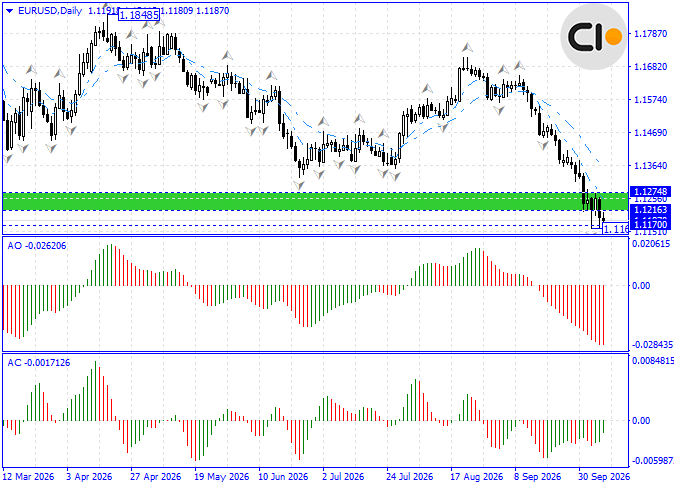
The key support and resistance levels ahead for EUR/USD are as follows:
- Third key resistance level of EUR/USD: 1.13700
- Second key resistance level of EUR/USD: 1.13200
- First key resistance level of EUR/USD: 1.12748
- First key support level of EUR/USD: 1.12163
- Second key support level of EUR/USD: 1.11700
- Third key support level of EUR/USD: 1.11300
EUR/USD Market Overview – October 7, 2026
EUR/USD has experienced a strong bearish trend over the past several weeks, during which sellers have so far managed to push the pair down to a low of 1.11604.
U.S. Dollar Fundamental Overview
Following its gains in recent weeks, the U.S. dollar has now entered a phase of pause and reassessment regarding the Federal Reserve’s monetary policy outlook.
The September employment report showed only 29,000 new jobs, while the unemployment rate rose to 4.2%, reducing the probability of an interest rate hike in October to around 20.5%. However, the market is still pricing in approximately an 84.5% probability of a rate hike in December. Therefore, for now, the discussion is about a delay in the rate hike rather than the end of the monetary tightening cycle.
On the other hand, inflation has yet to be brought fully under control. The core Personal Consumption Expenditures Price Index stood at 3.0% year-over-year in August, remaining above the Federal Reserve’s 2% target. High energy prices, tariffs, and other cost pressures could also make the disinflation process more difficult. For this reason, some Federal Reserve officials have not ruled out the possibility of further interest rate increases.
The 10-year U.S. Treasury yield, despite its recent decline, remains around 5.27% and continues to support the attractiveness of U.S. dollar-denominated assets. However, if elevated yields are driven more by concerns over the U.S. budget deficit and debt than by the strength of the economy, this factor could eventually lose its supportive effect on the dollar.
Overall: The short-term fundamental outlook for the U.S. dollar remains neutral with a positive bias, but fragile. Weakness in the labor market is preventing a strong dollar rally, while above-target inflation, elevated bond yields, and the possibility of a December rate hike continue to provide support. The Federal Reserve meeting minutes will now determine which side of this balance gains greater strength.
EUR/USD Technical Analysis
Following the recent declines in EUR/USD, the pair has moved into oversold territory, although the current chart structure is considered high-risk for buyers.
During the recent sell-off, price reached the 1.12748–1.12163 support zone, where further downside movement was halted. It appears that some sellers may be exiting their positions, as indicated by the formation of a long lower wick on the October 5 candle.
Between the 1.18485 price high and the 1.11604 price low, an AB=CD pattern can be observed with the ideal 76.4–127.2 ratios, suggesting the possibility of an upward move from point D.
Due to the strength of the recent decline, long positions are still considered high-risk. However, as long as the current support zone remains intact, price has the potential to rise toward the 1.13200 resistance level, and in a stronger bullish scenario, toward 1.13700.
In the opposite, bearish scenario, if candles establish themselves below the support zone, the first warning of further downside movement will be triggered. As long as price remains below this zone, it has the potential to move toward the 1.11700 support level.


