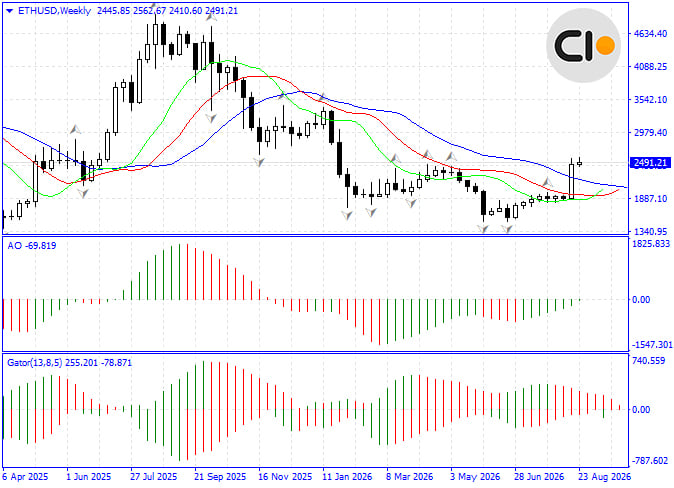
The key support and resistance levels ahead for ETH/USD are as follows:
- Third key resistance level of ETH/USD: 2800
- Second key resistance level of ETH/USD: 2600
- First key resistance level of ETH/USD: 2545
- First key support level of ETH/USD:2400
- Second key support level of ETH/USD: 2300
- Third key support level of ETH/USD: 2200
Ethereum: Renewed Hope for Long-Time Supporters!
As noted in the previous Ethereum analysis dated July 15, 2026, there was potential for an upward move toward the specified target levels, a scenario that ultimately materialized. Over the past week, Ethereum exhibited a powerful rally, during which buyers successfully pushed the price to a peak of $2,545.
Overview of Ethereum’s Fundamentals
Under current conditions, Ethereum’s fundamentals are evaluated as positive and leaning bullish, yet they remain conditional. The most significant backing comes from the return of capital demand via spot ETFs, extensive staking, and the preservation of the network’s economic depth.
Over eight consecutive trading sessions, Ethereum exchange-traded funds (ETFs) have recorded approximately $1.18 billion in net inflows. On August 26 alone, $192.4 million in fresh capital was attracted, of which $115.7 million was allocated to BlackRock’s Ethereum fund.
At the network level, a total value locked (TVL) of approximately $49 billion, nearly $148 billion in stablecoins, and roughly 2 million daily transactions indicate that Ethereum remains one of the most critical settlement and liquidity platforms in the cryptocurrency market.
Simultaneously, about 42.4 million ETH—representing nearly 35% of the total supply—has been staked, and the validator entry queue remains substantial. This supports network security and the demand for the productive use of Ethereum, although this volume should not be equated with a complete removal of supply from the market.
The primary weakness lies in the transfer of the network’s economic value to Ethereum itself. The network’s gross revenue in the first half of 2026 dropped by about 69% year-over-year, and low fees have meant that the token-burning mechanism cannot currently offset the issuance of new units. Consequently, Ethereum’s supply has temporarily reverted to an inflationary nature in the short term.
This indicates that the growth of the Ethereum ecosystem does not necessarily translate with the same intensity into an increase in Ethereum’s own economic value—an issue that currently stands as its most significant fundamental constraint.
Overall, the combination of capital inflows into ETFs, high staking rates, and the network’s liquidity depth continues to heavily tilt the fundamental scales toward the upside. However, for a more sustainable strengthening of Ethereum’s valuation, continued capital inflows must be accompanied by an improvement in network revenue and a return to strength for the token-burning mechanism.
Ethereum Price Action Analysis
In long-term timeframes, such as the weekly chart, Ethereum signals the potential for further upside by establishing and stabilizing a price bottom. The bullish orientation of the Stochastic oscillator (8,3,3) on the monthly timeframe further reinforces this probability.
Currently, the price is influenced by the $2,380–$2,460 resistance band, a zone where we have observed some buyers exiting their trades.
Given the current bullish structure, if prices stabilize above the aforementioned resistance band, there will be potential for further upward movement. In this scenario, buyers will attempt to capture the $2,600 resistance level, and in a more aggressive rally, up to $2,800.
In the alternative bearish scenario, the daily timeframe reveals the formation of a spinning top candlestick pattern—indicating uncertainty—alongside upper shadows on the candles. However, due to the underlying strength of the bullish rally, these are considered weak signals.
If the current price peak ($2,545) is not breached, there is potential for the price to pull back into the resistance band, and in a more severe correction, down to the $2,300 and $2,200 support levels.