- Is trading without KYC possible?
- Is it legal in 2025?
- What are the real risks?
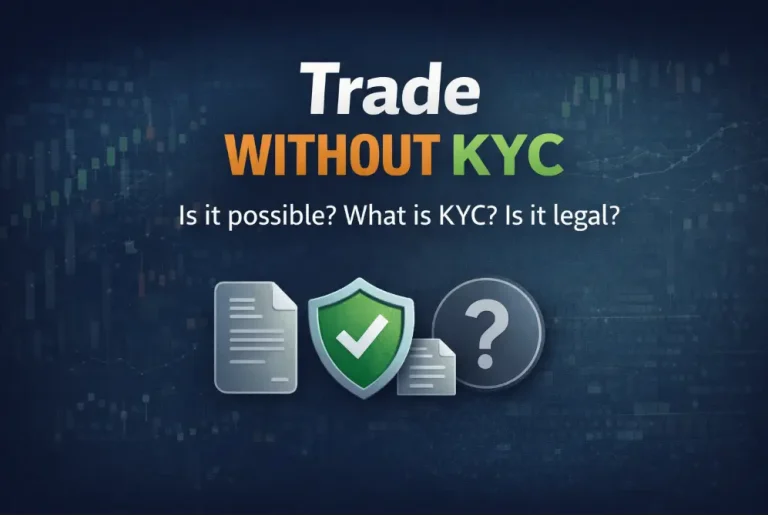
Is it possible? What is KYC? Is it legal?
A lot of question marks can appear in one’s mind when coming across trading without KYC (Knowing Your Customer) due to its legal terms and its surface complexities, such as: Is it possible? Is it legal?
Trading without KYC nowadays is a very common way for people to trade when they don’t want to verify their identity, which, on its own terms and conditions, allows users to trade without submitting personal identity documents to the platform.
What is KYC?
Corporations, companies, or any form of business institution are obligated to demand certain verification items from you due to legal purposes, which are different from company to company, but there are four essential items that are required in every company:
- Full legal name
- Date of birth
- Residential address
- Unique ID number (Social Security Number, National ID, or Tax ID)
KYC, as mentioned earlier, stands for Knowing Your Customer. It’s a (mostly) required process which businesses and financial institutions use to identify their clients (yes! so they can get to know you), so that they know who they are working with. Consider it a virtual handshake so that they know who they are doing business with.
Is it possible?
There is no doubt that anything has a way of approach, and to answer the question of this section, we can say yes, it is possible, but there is the question of how then?
Non-KYC trading depends on two vital factors:
What are you trading?
In this matter, the asset you are trading has the feature of personal verification necessity. In the cryptocurrency world, having an identified account is not necessary, whereas with stocks and bonds (traditional markets generally), you almost always need identification. Pay attention that non-KYC trading is only available if the deposit is crypto-based (Tether, Bitcoin, or any other cryptocurrency)
Which trading platform are you using?
Now that we know what assets can be traded (or not), the other important factor for us is that we need to find a suitable environment to do it. Here, you should know that in the cryptocurrency world, we can operate with and without identification, so trading anonymously is possible and works for a lot of people. In conclusion, you need a place where KYC doesn’t need KYC. CloseOption provides educational resources and market analysis to help users understand different trading models, including platforms with varying verification requirements.
Is it legal?
What you need to know about your rights
When you use a regulated platform like Coinbase or a regular bank, you have statutory rights. You mostly have contractual rights on a site that doesn’t require KYC, and these are much harder to enforce.
- No way to settle arguments: If a non-KYC exchange freezes your money or a trade goes wrong, you can’t call an ombudsman or the Consumer Financial Protection Bureau, and you have to depend on the site’s own help to solve your issue.
- The risk of EXIT SCAM: Many sites that don’t require KYC are based outside of the US. If the owners decide to close down and take all the money from users (an exit scam), the police in your country usually can’t help because the company isn’t legally registered there.
- Taking Assets: If the police suspect the platform is being used to launder money, they can seize all funds on the site, including yours, as part of a global investigation. Because you haven’t done KYC, it’s hard to prove that you were using it and that it is actually yours.
Important risks to watch out for
| Risk Factor | Impact on the Consumer |
|---|---|
| Solvency Transparency | Unlike regulated banks, non-KYC sites rarely undergo third-party audits. You have no way of knowing if they actually hold the funds you see in your balance. |
| Account Recovery | If you lose your 2FA or password, a non-KYC site cannot verify your identity via a passport. If their automated recovery fails, your funds are likely gone forever. |
| Market Manipulation | Without oversight, these platforms can “wash trade” or use bots to manipulate prices against users, with no legal penalties. |
| Withdrawal “Traps” | Some sites allow you to deposit without KYC but “trap” your money by demanding ID verification only when you try to withdraw a large amount. |
How to protect yourself (the do it yourself way)
You have to be your own Compliance Officer because the law won’t keep you safe:
- You have to keep your own stuff: Don’t put a lot of money on an exchange that doesn’t require KYC. Only use the site to trade, then move your assets right away to a private wallet, such as a hardware wallet, where you have the keys.
- Verify the Canary: Check community sites like Reddit, Trustpilot, and Twitter every day. When users start to report delayed withdrawals, the platform is usually not working.
- Use burner information: Even if you don’t need a passport, you should still use a VPN and a separate, encrypted email account like Proton Mail. This keeps your real-world identity from being linked to the account if the site is ever hacked.
- Small batches: Never send your whole balance at once. To make sure the platform really does let money out, try the withdrawal pipe with a small amount first.
| Feature | Regulated (KYC) | Non-KYC |
|---|---|---|
| Fraud Protection | High (Legal recourse/Insurance) | Low (Self-reliance) |
| Privacy | Low (Govt. has your data) | High (Anonymity) |
| Account Access | Recoverable with ID | Often lost if credentials go |
| Regulatory Risk | Low (Compliant) | High (Risk of sudden shutdown) |
Is it popular?
Getting hands on exact numbers in this case is a hard thing to ask, but since there are on-chain data (which tracks active wallets) and market share reports, we are able to get reliable figures. Global statistics show that it is popular and growing worldwide:
- Estimated user base: Based on MAA (monthly active addresses) counts from Dune Analytics, there are about 25 million to 40 million unique active wallets interacting with decentralized (non-KYC) protocols every month.
- Monthly Active Users (MAUs): As of late 2025, there are approximately 195 million to 250 million active users across the top 25 decentralized protocols.
- Stablecoin Growth: A significant portion of non-KYC activity is tied to stablecoins. Monthly active users for stablecoins (often used in non-KYC P2P and DEX trading) grew by 25% in 2025, reaching roughly 50 million unique active addresses.
- Global Context: With total crypto ownership reaching 560 million people globally in 2025, roughly 1 in 3 crypto users interacts with a non-KYC or decentralized service at least once a month.
| Category | Figure | Primary Source |
|---|---|---|
| Total Global Crypto Users | ~560 Million | Triple-A / Statista |
| Active Non-KYC/DEX Wallets | ~195 Million | 21Shares / Dune Analytics |
| Largest Non-KYC Exchange Vol. | $150.4 Billion (Monthly) | CoinGecko (MEXC Data) |
| Inflow Growth (No-KYC) | +82% Year-over-Year | Chainalysis |
| P2P/Non-KYC Volume (Russia) | $376.3 Billion (Annual) | Chainalysis |
This table aggregates data from multiple publicly available industry research reports, including Triple-A, Statista, CoinGecko, Dune Analytics, 21Shares, and Chainalysis.
Non-KYC Statistics (2025)
Conclusion
Trading with or without KYC will not have any effect on trading. It’s a choice people make for all sorts of reasons, and everyone has a reason of their own, whether it’s ethical or for better trading efficiency.